
Chimney Sweep: Repair or Replace? How Fountain Valley Homeowners Decide
Most “you need a whole new chimney” recommendations are really component replacements wearing a whole-system costume. A crown is not a liner. A chase cover is not a firebox. Until you can tell those parts apart, you can’t tell whether the scope you’ve been quoted is accurate or inflated. This guide breaks the system down piece by piece, shows the objective thresholds that separate a repair from a replacement, and explains how Fountain Valley’s mild, humid-adjacent climate quietly shapes which components fail first. Read it before you sign anything.
What are the parts of a chimney system, and which ones fail first?
A chimney is not one thing that wears out on one schedule. It’s a stack of components, each with its own job, its own lifespan, and its own failure mode. Homeowners who understand this can follow a technician’s assessment instead of nodding along. Here’s the breakdown we walk through with Fountain Valley homeowners on the roof and at the firebox:
- Crown – the concrete cap at the very top that sheds water away from the flue. It cracks from sun and thermal movement; a hairline crack becomes a path for water into the masonry below.
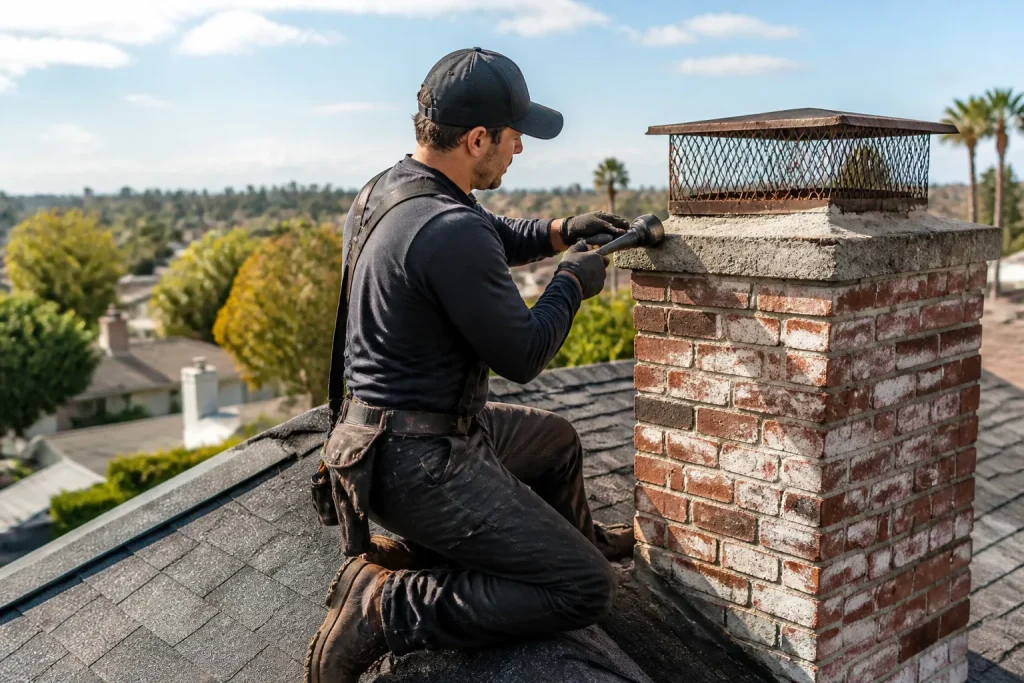
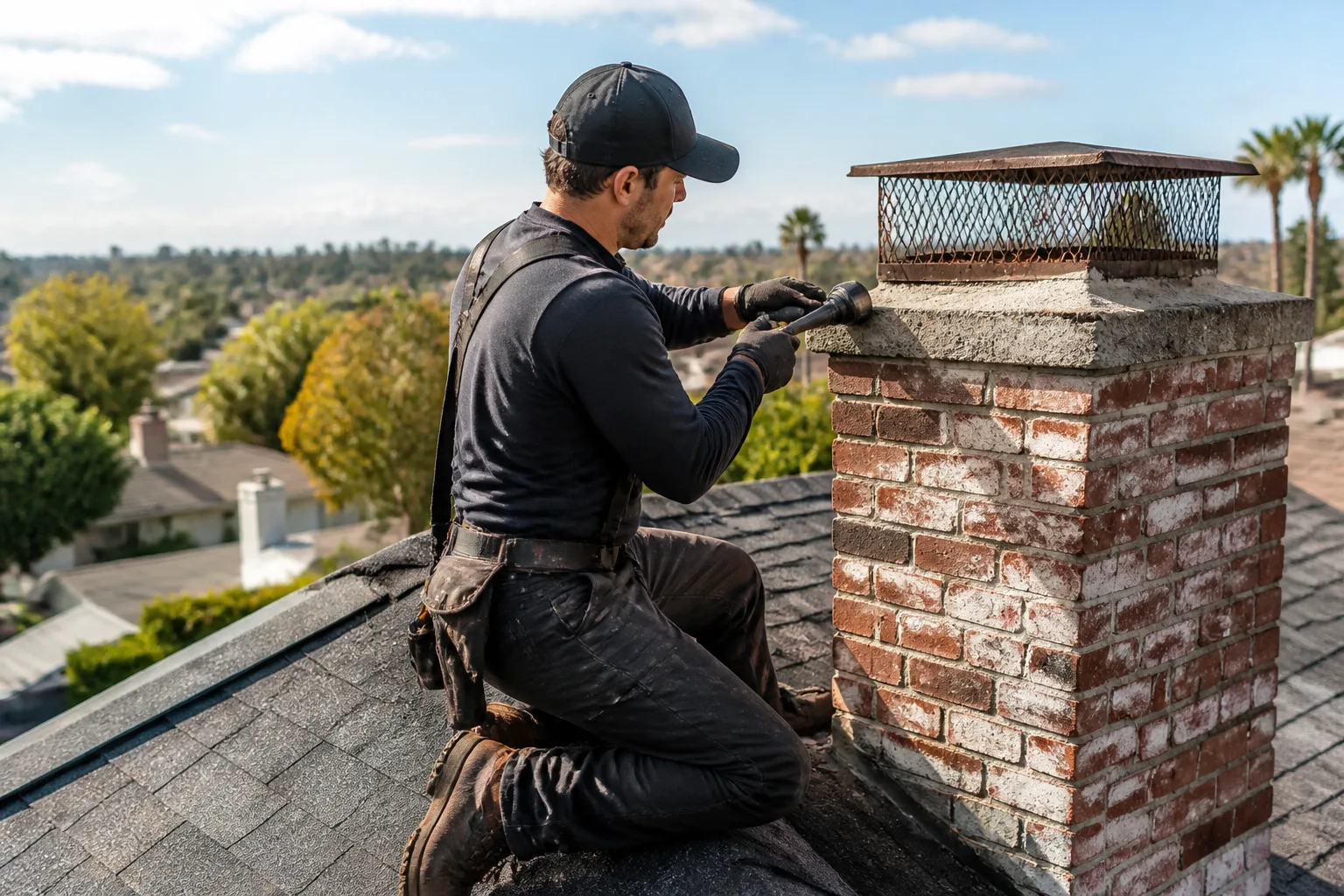
- Chimney cap – the metal or mesh cover over the flue opening. It keeps rain, birds, and debris out and sparks in. Screens rust through and caps lift in wind; these are common replacements, not rebuilds.
- Flue liner – the clay tile or metal lining that carries combustion gases up and out. Cracks, gaps, and spalling in a clay liner are the single most consequential finding in an inspection.
- Firebox – the masonry box where the fire actually burns. Heat, moisture, and repeated firing cycles erode the brick and mortar joints over time.
- Damper – the metal plate that seals the flue when the fireplace is idle. They rust, seize, or warp and stop sealing.
- Chase and chase cover – the exterior enclosure on a prefab system and its metal top. Chase covers corrode and leak at the seams.
Notice how many of these are small, localized items. A rusted cap or a cracked crown is a component repair, full stop. Categorizing that as “chimney replacement” is where most inflated quotes begin.
When does a repair cross the line into a replacement?
This is the question that decides your budget, and it deserves a straight, criteria-based answer rather than “it’s too far gone.” In our experience, the threshold is different for every component. Here’s how we draw the line for each one in Fountain Valley homes:
- Crown: Isolated cracks can be sealed. Once the crown has separated from the flue or lost its slope, it gets rebuilt – a defined repair, not a system replacement.
- Cap and chase cover: Replace when rust has perforated the metal, the screen is torn, or the cover no longer sheds water. These almost never justify going further up the system.
- Liner: A few isolated cracks in clay tile can sometimes be resurfaced. Widespread spalling, offset tiles, gaps at the joints, or a flue that was never lined at all crosses into replacement territory. HeatShield resurfacing can restore a damaged flue interior without the cost of a full liner when the structure underneath is still sound.
- Firebox: Rebuild the firebox when the brick face is eroded or mortar joints are deeply recessed. A localized repair stays a repair; a firebox that’s compromised across its whole face gets rebuilt.
- Damper: Replace, essentially always. A seized or warped damper is a component swap.
- Chase: Repair the cover and flashing before you consider anything structural. Water intrusion is usually a top-of-chase problem, not a whole-chase failure.
The honest test: if a single component has failed and the rest of the system is sound, you repair that component. If the liner, firebox, and crown are all deteriorating together, replacing the flue system starts to make sense. Most Fountain Valley jobs we assess land in the first category.
How does Fountain Valley’s climate affect chimney degradation?
Fountain Valley’s climate is gentle – mild winters, no hard freeze, no snow load – which means the classic cold-climate failure patterns (frost heave cracking masonry, ice damming at the crown) aren’t the main story here. What does drive degradation is moisture exposure combined with the local air, which carries more humidity and mild salt influence than inland or mountain homes experience. Masonry and metal components weather on a different clock than they would in a colder or drier climate.
What that looks like in practice for Fountain Valley homeowners:
- Metal components – caps, chase covers, dampers, and flashing – corrode faster here than they would forty miles inland. A stainless cap from a commercial-grade line like Gelco or Famco outlasts a bargain-bin cover by a wide margin.
- Masonry and mortar – the humid air keeps exterior brick and mortar damp longer between rains, which accelerates spalling and joint erosion. A well-sealed crown and a properly fitted cap are your first line of defense against that moisture.
- Liner interiors – moisture from a cap that no longer seals, combined with the condensation cycle in a mild climate, is what pushes clay liners toward cracking over time.
The takeaway: in Fountain Valley, weather protection isn’t cosmetic. Cap, crown, and flashing work is the preventive layer that slows everything underneath. A clean chimney is just the starting point – cap, crown, and liner condition determine whether it stays that way. It’s why we lean on professional-grade lines like Olympia Chimney for liners and Gelco and Famco for caps and covers – the same materials chimney specialists specify across the country, not hardware-store substitutes.
The financial logic: when is a repair worth it, and when is it a two-year patch?
Here’s the math that should drive the decision. A repair is worth it when it extends the useful life of the system by a decade or more. It’s a patch when it buys you two years and then you’re back where you started, minus the cost of the first repair. So ask directly: “If I do this repair, how many more years should I expect before the next major work on this component?” A straightforward answer is a green flag. A vague one is not.
Some guiding principles we share with Fountain Valley homeowners:
- Component repairs age well when the underlying structure is sound. A rebuilt crown, a replaced cap, or a resurfaced flue that’s structurally intact will serve for years.
- Patches on a failing liner don’t. If the liner is spalling across its length, sealing one crack just moves the problem.
- A full replacement earns its keep when the liner, firebox, and crown are all in decline simultaneously – you’re essentially rebuilding the system, so replacing it once is cheaper than rebuilding each part in sequence.
- Ask for the age math in writing. A repair that extends life 12 years is a good investment. A repair that buys 2 is a rental.
The repair-vs-replace decision rarely is binary. It’s a component-by-component call, and the homeowner who asks for the life-extension number on each line item is the one who gets a fair scope.
What should a written scope of work include before you sign?
Before any repair or replacement contract, demand a written scope. The missing items are where scope creep and under-specification hide. Here’s what a complete scope in Fountain Valley should contain – and what to watch for when it doesn’t:
- Component-by-component listing – each item named separately (crown, cap, liner, firebox, damper, chase) with the action and the reason. A lump-sum “chimney repair” line is a red flag.
- Product brands and specifications – for a liner, the brand (DuraFlex is a leading professional-grade flexible liner system) and for a cap or cover, a commercial-grade source like Gelco or Famco. Unnamed materials mean uncontrolled quality.
- Measured condition findings – photos or a camera record of what was actually found, not just a verdict. You should be able to see the evidence.
- The life-extension estimate – the expected years added by each repair line.
- Code-compliance notes – if the flue isn’t lined or the liner isn’t compliant, the scope should say so in plain terms.
- Exclusions – what the contract does not cover, so nothing sneaks in later.
Three missing items should make you pause: no brand or specification on the liner, no photos of the condition, and no statement of how long each repair is expected to last. If a contract has all three, ask why.
When to call a pro
If your inspection turned up cracks in the flue, a crown that’s pulling away, or a firebox with deeply eroded joints, this is beyond a DIY check. Liner work and masonry repair around the flue involve combustion gases and structural integrity; a trained professional should handle it. We can walk through what a typical job involves and get you a written scope you can actually evaluate.
Related services in Fountain Valley
If you’re comparing repair against replacement, you may also want to look at our chimney repair and fireplace repair pages, and the main chimney sweep service to understand the annual cleaning that keeps you ahead of these decisions.
The Bottom Line
Repair or replace isn’t a single yes-or-no. It’s a component-by-component analysis: crown, cap, liner, firebox, damper, and chase each have their own lifespan and failure mode, and the right call depends on whether the damage is isolated or system-wide. In Fountain Valley’s mild but humid climate, moisture protection at the top of the system (cap, crown, flashing) is what buys the rest of the chimney its time. Ask for the life-extension math on every line, and demand a written scope that names brands, shows photos, and states what’s excluded. If it does, you can sign with confidence. If it doesn’t, ask why.
If you’re in Fountain Valley and need help, Chimney Sweep Fountain Valley offers free estimates – call (877) 792-7543. We answer 24/7. Fast dispatch, 7am-7pm, Sunday through Friday. One company from inspection through repair, no handoffs.
Frequently Asked Questions
A routine chimney sweep in Fountain Valley is quoted per job by written estimate, and the estimate is free. The price depends on the system (wood-burning vs. gas), accessibility, and whether a camera inspection is included – we include a camera inspection and photo report so you can see what’s there before any work begins. Call (877) 792-7543 for an exact quote; estimates are free.
Resurfacing is enough when the liner has isolated cracks and the structure underneath is still sound; a full replacement is warranted when the damage is widespread, tiles are offset or spalling, or the flue was never lined at all. HeatShield resurfacing can restore a damaged flue interior without the cost of a full liner when the structure holds. The deciding factor is what the camera inspection shows – and we show it to you. Call (877) 792-7543 for an exact quote.
Most wood-burning chimneys should be swept and inspected once a year; gas fireplaces also benefit from annual inspection to catch liner and venting problems early. Regular sweeping keeps creosote buildup in check – the leading driver of chimney fires – and annual inspection is the moment when a small, cheap repair gets caught before it becomes a replacement. Call (877) 792-7543 to book an inspection.
Skipping annual service lets small problems compound: creosote builds up and raises chimney fire risk, cracked liners and failing crowns let moisture into the masonry, and what would have been a component repair becomes a full-system rebuild. None of that is a sales pitch; it’s how the degradation curve works. The good news is that a camera inspection shows exactly where you stand, and we’ll tell you plainly when work can safely wait. Call (877) 792-7543 for a free estimate.
Written by the team at Chimney Sweep Fountain Valley.
Need Chimney Cleaning Help?
Call Chimney Sweep Fountain Valley - the local pro we connect you with is licensed and insured, with free written estimates in Fountain Valley.
(877) 792-7543