
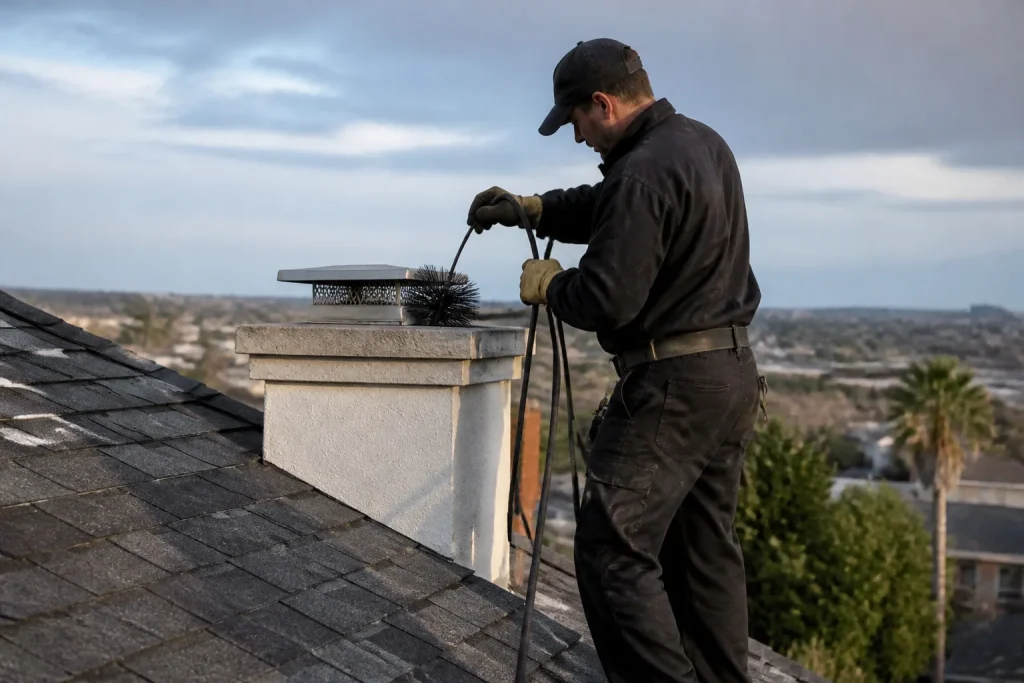
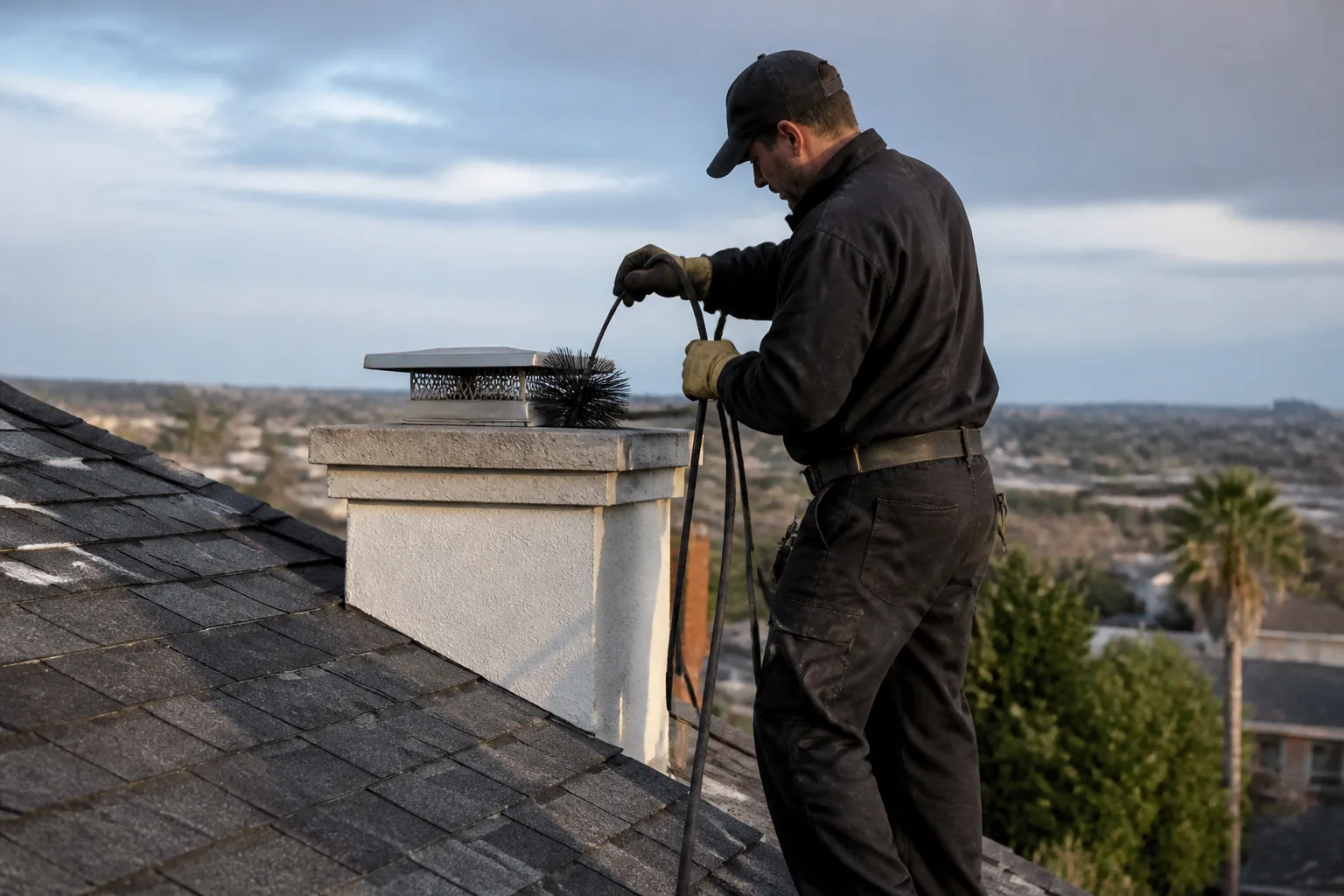
Emergency Chimney Sweep Near Me: What Fountain Valley Homeowners Should Do First
Most chimney emergencies in Fountain Valley aren’t truly unpredictable. They’re the result of a condition that was visible weeks earlier – a cracked flue tile, a nest packed into the cap, a creosote glaze building quietly through the burn season – that nobody acted on. If you’re reading this with smoke in the room, start with the first 30 minutes. Do the right three or four things, and you’ll either keep a small problem small or get the right help moving fast. If you’d rather skip the triage and talk to a specialist, call (877) 792-7543. We answer 24/7.
Key Takeaways
- Decide first whether you have a fire, a blockage, or a stalled draft – each one calls for a different response.
- Close the fireplace doors and cap the damper if you smell smoke or burning inside the flue; leave everything open only if the problem is poor draft and smoke is already in the room.
- An “emergency sweep” (cleaning) and an “emergency inspection” (assessment) are separate services. Confusing them leads to incomplete fixes.
- Cracked flue tiles, smoke rollback, or odor that returns after a cleaning mean the sweep alone won’t solve it – the next step is inspection and repair.
Do You Need to Call 911, Book a Sweep, or Schedule an Inspection?
Start with one question: is there fire where fire shouldn’t be? That single check separates the three responses. Here’s the decision framework we walk homeowners through.
Call 911 if:
- You see flames, sparks, or glowing material on the roof, in the attic, or outside the chimney.
- The chimney is making a low roaring sound like a distant train, or the flue is hot to the touch through the surrounding wall.
- Smoke is filling the room and you can’t stop it by opening a window or closing the damper.
- Anyone in the home has a headache, dizziness, or nausea that clears when they go outside. That’s a possible carbon monoxide situation, and you should leave the house and call from outside.
Book a same-day sweep if:
- Smoke backs up into the room when you light a fire, and there’s no fire in the flue itself.
- You hear animals or scratching in the chimney, or you can see a nest blocking the top.
- Draft is weak, the fire smokes lazily, and you haven’t had the flue cleaned in a while.
Schedule an urgent inspection if:
- You’ve had a chimney fire in the past and want to know the damage before lighting again.
- You smell a persistent creosote or soot odor even when the fireplace is cold.
- You’re buying or selling a Fountain Valley home and an inspection report flagged the chimney.
If you’re not sure which category fits, call and describe what you’re seeing. We’d rather help you sort it over the phone than have you guess wrong. Call (877) 792-7543. We answer 24/7.
What to Do With Your Fireplace Before the Technician Arrives
Between the moment you notice the problem and the technician’s arrival, your job is simple: keep the situation from getting worse and don’t make it harder to diagnose. Here’s what we tell Fountain Valley homeowners.
If you suspect a chimney fire:
- Get everyone out and call 911 from outside. Don’t wait to see if it “settles down.”
- Once the fire department clears the house, don’t light another fire until the flue has been inspected. Chimney fires can crack tiles and warp metal liners in ways you can’t see from the hearth.
- Close the fireplace doors and cap the damper if you can do it safely and the fire department has told you to. That cuts the air supply to the flue.
If you have a blockage or a draft problem:
- Put the fire out with a proper extinguisher or by smothering it, then let the flue cool completely.
- Leave the damper open if smoke is already in the room. You want the smoke to have somewhere to go, and open is the better of two bad options.
- Open a nearby window a crack to give the smoke a path out of the living space.
- Don’t run a shop vac, a leaf blower, or anything else that might push air back down the flue.
- Don’t try to reach into the firebox or up the flue with a tool to clear a nest or debris. You’ll either loosen something into the smoke shelf or hurt yourself.
What you should never do, in any scenario: relight the fire to “see if it was a fluke.” That’s how a small creosote fire becomes a big one. And we say this kindly – we’ve seen it more than once.
Emergency Sweep vs. Emergency Inspection: Why the Distinction Matters
These are two different service calls, and confusing them is how homeowners end up with an incomplete fix. A sweep cleans. An inspection assesses. A sweep performed without an inspection can leave a cracked flue tile, a failed liner joint, or a damaged crown completely undiagnosed – and that’s exactly the kind of condition that produces the next emergency.
In our experience, the sequence should always be inspection first, then cleaning, then repair as needed. For a well-maintained system, the annual sweep is routine. For a system that’s already shown symptoms – smoke rollback, persistent odor, a past fire – the inspection comes first because we need to know what we’re working with before we touch anything.
This matters in Fountain Valley because much of the housing stock runs older flues. Some are unlined or have clay tile liners that have aged past their service life. An inspection tells us the difference between a chimney that needs a sweep and a chimney that needs a DuraFlex liner system to bring an older flue up to code compliance. That’s a repair conversation, not a cleaning conversation.
If a sweep is what you need, we’ll tell you. If it’s an inspection or a chimney repair, we’ll tell you that too – with photo evidence you can see for yourself before any work is agreed.
What Fountain Valley’s Permit and Inspection Requirements Mean for You
Most cities require a permit for structural chimney work, and Fountain Valley is no exception in the broad sense – if a repair involves the flue liner, the crown, or the chimney structure itself, it’s worth a call to the city’s building department to confirm what’s needed before work starts. We always recommend that step, because an unpermitted repair becomes a problem at resale time.
If you’re selling a Fountain Valley home, the inspection report stage is where chimney findings tend to surface. A buyer’s inspector flags a cracked crown, a missing cap, or a deteriorated flue, and suddenly you’re fielding repair requests. This is where a documented inspection report from a chimney specialist helps: it tells you which findings are urgent and which can be addressed in the normal course of maintenance. Not every flagged item is a dealbreaker, and knowing the difference saves both time and negotiation.
For property managers overseeing rental or multi-unit buildings in Fountain Valley, the same logic applies at scale. Documented inspections create a record that protects you if a tenant reports an issue, and they answer the question a future buyer will certainly ask: has the chimney system been maintained?
If you’re unsure where you stand, a free estimate from Chimney Sweep Fountain Valley starts with a look at what you actually have. Call (877) 792-7543.
Red Flags That Mean a Sweep Alone Won’t Fix It
A sweep clears creosote, soot, and debris. It doesn’t fix damaged components. After the flue is clean, the question becomes: is the system itself sound? Here are the signs we watch for that tell us the answer is no.
- Cracked or missing flue tiles. Visible as broken pieces, crumbling mortar joints, or gaps in the liner when inspected. A cracked tile lets heat and gases into the surrounding structure, which is a real fire risk – and it’s beyond the reach of a sweep.
- Smoke rollback that continues after cleaning. If smoke still spills into the room when the flue is clean and the damper is open, the problem is usually draft – often the wrong flue size, a flue that’s too short for the fireplace opening, or an obstruction downstream of the damper.
- Persistent odor after cleaning. A creosote or soot smell that returns even when the fireplace is cold usually means the flue lining is saturated or damaged. Cleaning removes surface deposits; it doesn’t seal a compromised liner.
- A chimney fire in the recent past. Even a small fire can crack tiles or distort a metal liner. The only way to know is a camera inspection.
- Visible damage to the crown or cap. A cracked crown lets water into the chimney structure, which leads to spalling brick and rusted dampers over time. Cap and crown work is a repair, not a cleaning item.
When these come up, the next step isn’t another sweep. It’s an inspection with a camera and a plan. HeatShield resurfacing can restore a damaged flue interior without full liner replacement when the condition allows. When it doesn’t, a DuraFlex liner system is the standard professional-grade upgrade. Caps and covers from Gelco and Famco address the weatherproofing side of the equation, so the system stays sound between cleanings. We use these brands because they’re the same lines specified by chimney professionals nationwide, not hardware-store substitutes.
Why “Emergency” Usually Started Weeks Earlier
We’re not going to tell you every chimney fire was preventable. Some aren’t. But the pattern we see again and again is a warning sign that was misread or waved off. A little smoke on a cold start. A faint smell in the room when the fire was out. A crown that’s been chipping for a season or two and never got looked at.
Each of those is a small thing on its own. Together, they’re the reason the call usually comes in at the worst possible moment – on a cold evening, with company over, with smoke in the room.
Annual inspection and cleaning catch most of these conditions while they’re still small. That’s the whole point of the yearly service – not to upsell a sweep you don’t need, but to catch the crown crack, the failed liner joint, or the nest in the cap before it becomes a fire risk. In Fountain Valley, an annual check also documents the condition of the system, which matters when you sell.
If it’s been more than a year since the chimney was inspected, the right move is to book it before the next burn season, not after. That’s not a sales pitch – it’s just how you avoid the emergency in the first place.
When to Call a Pro (and What to Expect)
If you’ve read this far and you’re still not sure whether your situation is a fire, a blockage, or a draft problem, call us. We help Fountain Valley homeowners sort it over the phone without making you feel silly for asking. If you need a technician on site, we answer 24/7. A call outside dispatch hours is booked into the next opening, Sunday through Friday, 7am to 7pm.
Here’s what a professional visit looks like. A technician inspects the flue with a camera, sweeps the firebox and flue, and gives you a written report with photos of anything flagged. Nothing gets recommended without camera evidence. If the condition can safely wait, we say so. The price is set per job by the written estimate, and estimates are free.
Our technicians have up to 15 years of experience, and they work with the brands that chimney specialists actually specify – DuraFlex for liner systems, HeatShield for resurfacing, Gelco and Famco for caps and covers. That means one company handles the full scope from inspection through repair, with no coordination between contractors.
Related services in Fountain Valley: If you need a routine cleaning, book a chimney sweep. If the fireplace itself needs attention, our fireplace repair team handles that work. For the full picture of what we do, visit Chimney Sweep Fountain Valley.
The Bottom Line
Most chimney emergencies start as a small, fixable condition that goes ignored. The three-step protocol is straightforward: decide if you need 911, a same-day sweep, or an urgent inspection; keep the fireplace safe between now and the technician’s arrival; and understand that a sweep and an inspection are different services. If you’re in Fountain Valley and the chimney has been giving you warning signs, the best move is to get it looked at before the next burn season, not after. Chimney Sweep Fountain Valley offers free estimates and honest answers about what your chimney actually needs. Call (877) 792-7543. We answer 24/7.
Frequently Asked Questions
We price each job by written estimate after we’ve inspected the chimney, so we don’t quote a flat number over the phone. The estimate is free, and the price is set per job based on what the chimney actually needs. If the issue turns out to be a repair rather than a sweep, we’ll tell you that instead of cleaning and leaving you with the same problem. Call (877) 792-7543 for an exact quote – estimates are free.
If the flue tiles are intact and the liner joints are sound, a sweep is enough. If the camera inspection shows cracked tiles, failed joints, or a deteriorated interior, a repair or liner upgrade is necessary to make the flue safe to use. HeatShield resurfacing can restore many damaged flues without full liner replacement. DuraFlex liner systems are the standard upgrade when resurfacing isn’t appropriate. Nothing is recommended without camera evidence you can review. Call (877) 792-7543 to book an inspection.
Once a year is the general guideline for a wood-burning fireplace, and it matches the annual inspection that catches crown and cap problems before they become repairs. Gas fireplaces need less frequent sweeping but still benefit from an annual inspection. If you burn often or the fire smokes, have it checked sooner. Call (877) 792-7543 to book the yearly service before the next burn season.
Creosote builds up along the flue and becomes harder to remove the longer it sits. A glazed creosote layer is the most volatile kind, and it’s the leading factor in home heating fires according to the NFPA. Skipping the annual service also means small problems – a cracked crown, a failed liner joint – go unnoticed until they’re big ones. If it’s been more than a year, call (877) 792-7543 and we’ll get you on the schedule.
Written by the team at Chimney Sweep Fountain Valley.
Need Chimney Cleaning Help?
Call Chimney Sweep Fountain Valley - the local pro we connect you with is licensed and insured, with free written estimates in Fountain Valley.
(877) 792-7543